8 Ball In The Wind

Friday, March 13, 2020

Is The Washington Traffic Safety Commission Really Clueless On Motorcycle Safety?


For years ABATE of Washington and other motorcycle groups and riders have met with legislators and other state agency officials trying to inform and educate them on the basic knowledge on motorcycle helmets.  Even their own documents have been used to demonstrate their lack of proper information on even the most basic concepts regarding motorcycle helmets.  At one point during a legislative hearing, a Washington State Patrol Captain actually was reduced to stating that helmets protected riders from debris like "flying lugnuts".  Motorcyclists have sat down and met with agency officials to discuss even the most basic information in the hopes that finding a common and correct basis for discussion could be found.  From there, progress could be made with both sides having good information that decisions can be based upon.  However, it is becoming quite clear that WTSC is much more concerned with their political agenda than it is in facts when it comes to motorcycle safety.

Take a moment to watch this short video from the Washington Traffic Safety Commission.  See if you can catch the blatant error this video makes within the first four seconds.  The WTSC and its constituent member organizations have been supposedly "listening" to us for decades.  Yet still can't get even this most basic fact right about helmets.

At the three-second point of this video, the caption reads; 'WEARING D.O.T. APPROVED HELMETS".  There is no such thing as a "D.O.T. Approved" helmet.  The National Highway Transportation Safety Administration does not "approve" helmets.  Or any other piece of equipment that they have created the D.O.T.standard for.  The federal helmet standard (FMVSS-218) sets the minimum specifications for motorcycle helmets.   However, it does not even require manufacturers to test the helmets before they self-certify that the helmets meet the standard.  Manufacturers merely need to believe their helmet can meet the specification in order to self-certify the helmet meets the D.O.T. standard.  This certification will stand until the model helmet is randomly chosen for independent laboratory testing.  If the helmet fails testing its certification is revoked.  But little chance the thousands of owners of that model helmet will receive that knowledge.

After so many years of listening to this very basic fact, the WTSC still can't even seem to get it right.  If they were ever actually listening in the first place.  Would it not seem logical for a governmental agency to at least accept facts when presented with the proof of the fact by the government agency that determines the fact?  This is the opposite of what has happened.  Numerous times, members of the WTSC have been shown documents from NHTSA stating that they do not test or approve helmets.  Yet WTSC has continued for decades to use the term D.O.T. APPROVED HELMETS.

The fact that the D.O.T. standard is by far the lowest, minimal standard is rarely if ever mentioned by WTSC.  The other helmet standards require testing and have a much higher impact force than do D.O.T. helmets.  The impact velocity of a D.O.T. helmet is 13.4 mph.  This is the same as if you were sitting stopped on your motorcycle and fell over sideways, striking your head.  No forward velocity is even factored in by the standard.

The second video would also seem to cast doubt as to whether the WTSC has ever listened to motorcyclists, or even seriously considered and realized that motorcycles are inherently different than automobiles.  This video starts with the classic trope of motorcycles accounting for only 4% of registered vehicles, yet 15% of fatalities.  Think about that for a moment.  Picture the average automobile with an occupant in your mind.  Now, imagine a motorcycle and a rider.  See any difference?  Rather obvious, isn't it?  While the statistic that 75% is due to rider error is correct, it is only partially correct.  The initial loss of control and primary impact with the road surface may be due to rider error, but it is often the secondary impact with a fixed object that tends to be of a higher risk statistically.

The following statistic that on average, 39 motorcyclists die during July, August, and September, is a red herring.  It is statistically true, but only because there are a much greater number of motorcyclists riding during those months.  Would it not seem strange if fatalities should spike during a period with low ridership?

The following stat regarding 50% of fatalities involved speed & lane departure can also be misleading.  Partially due to the fact that if you are involved in a crash, and you land beyond the centerline, it is noted as a "lane departure".  This stat also ties in with a very strong correlation to the 75% rider error stat.  For example; if you are riding through a flat corner, let's say 5 mph over the limit and you realize the corner is reducing in diameter, and you lay the bike down.  You as the rider were in error for going too fast.  However, you survived the impact with the ground and slid across to the outside of the turn (lane departure) before striking the post of the guardrail at an angle and velocity that resulted in death.  Studies have shown that roadside fixed objects, like guardrails, are 7 times more likely to be fatal to a motorcyclist than the initial impact with the road surface.  According to an NHTSA report, 50% of guardrail related fatalities are motorcyclists.  Automobiles have protective shells and other features to protect their occupants.  Motorcyclists have only what we wear.  That is a key point that WTSC officials seem to be unable to grasp totally.

Another point I would like to comment on about this video is regarding all the motorcycles in it are riding on a track and not a roadway.  Watch the bikes, and disregard the words as you do.  These riders are not maintaining lane position as they would on a roadway.  They are doing what on a roadway would be "cutting the corner" to maintain a close line on left curves.  They are practicing riding skills, but what the video shows them doing would likely result in crashes with other vehicles, and definitely could be called "lane departures".  That is great to do on a track because there is no traffic coming the other way.  But there is an old adage that "you do as you train".  If you train to take a left-hand curve close to the inside of the curve as possible on the track, you may do just that on some remote series of "S" curves in the mountains.  Which if traffic is coming the other way, it may lead to some tragic results.  Yet the WTSC video sees nothing contrary between their safety statistics message, and the motorcycles riding in the same video.

Then finally, of course, there is the requisite referral to "Target Zero".  The desired reduction to zero serious injury or fatal crashes in Washington by 2030.  The WTSC always makes references to the goal, but rarely provides substantive concepts on how to reach their goal.


There are more videos that I will be critiquing.  But for now, these two are a good start.  Besides, some of the others I will be describing more the manipulative way the videos are put together to push an agenda more than simply discuss a subject.

Catch you on the road sometime...

Coronavirus (Covid-19) Will Most Likely Significantly Affect the 2020 Riding Season


According to the CDC, Washington State has significantly more cases than any other state in the United States, including at this time California and New York.  As of 4:00 PM on March 12, 2020, there were 457 confirmed cases in Washington State.  Nationwide there are 1629 cases, with 41 deaths.  Only Idaho, Alabama, and West Virginia have not reported any cases as of this time.

With Washington's Governor banning all public gatherings in Pierce, King and Snohomish Counties, at least a few motorcycle events have had to be canceled.  Some with only a day or two of notice.  Both the ABATE of Washington Motorcycle Swap Meet, the 2020 Spokane Motorcycle Show and Sale, and the Northwest Classic Motorcycle Club's Indoor Show and Swap Meet have all been canceled.  As we enter the phase of this pandemic here in the US where both the number of cases and fatalities begin to sharply rise, it is not unreasonable that more restrictions are coming.

The CDC has issued mitigation strategies for Seattle and the three most affected counties in Washington State.  CDC has suggested:

1. Monitor local information about COVID-19 in your community.
2. Practice personal protective measures (e.g. hand washing).
3. Put a household plan into action
4. Ensure a 30 day supply of all medicines.
5. Individuals at risk of severe illness should stay at home avoiding gatherings or other situations of potential exposures, including travel, church attendance, social events with 10 or more people
6. Other individuals without such risk factors should adapt to disruptions in routine activities (e.g., school and/or work closures) by using remote participation such as telework where feasible or online classes or home study (E-learning).


With the beginning of the general riding season here in the Pacific Northwest only just getting underway, there are concerns that more restrictions may cause the cancellation of more motorcycle events and runs.  Even though this virus seems to affect those over 60 and those with existing health issues, it has been pointed out that we are approximately 50 days behind China in the growth and spread of this disease.  While this means that China appears to have begun to see a decline in cases, the US is only just beginning to see cases ramp-up.  For that reason, it would not be surprising to see further cancellations or declining attendance at motorcycle runs in the next month or two.

As a community, we will have to endure what is to come and ride it out.  Motorcyclists are not unfamiliar with risks in life.  Covid-19 is simply the latest risk we all share.  As motorcyclists, we are familiar with the risks involved with riding.  For this outbreak, we should become familiar with the risks it presents us all, and understand that there are things we can do to help ride-out the suddenly rough road ahead of us.  To give everyone a better understanding of what we face, so that we can each understand what precautions to take, here is a video from the CDC dated March 9, 2020.  I hope it answers some questions you may have.


Stay healthy...

Catch you on the road sometime...


Thursday, March 12, 2020

Governor's Ban Forces Cancellation of ABATE of Washington's Motorcycle Swap Meet


With this proclamation, The ABATE of Washington 2020 motorcycle Swap Meet was forced to cancel with just two weeks prior to the event.  While this ban is only in effect in Snohomish, King, and Pierce counties, it does encompass the Evergreen State Fairgrounds in Monroe.  With no time to find a new venue outside the area of the ban or time to reorganize security, and inform all the vendors of any change, ABATE of Washington issued the following announcement canceling the event for 2020.

"Per order of Washington's Governor Inslee: events over 250 people are banned in Snohomish County until further notice.
In light of this, we have no choice but to CANCEL this year's Motorcycle Swap Meet.  We want to thank you for supporting ABATE of Washington and our riding community through these very difficult times and we will be hosting this event resuming in March 2021.
To our valued vendors: The Swap Meet Committee and our State Treasurer are working out details now and you will be contacted shortly with information.  We appreciate your patience."

With fears of the risk of increasing the spread of the Coronavirus (Covid 19), this reaction is understandable, even though unfortunate.  It seems there are no other alternatives for this year's Motorcycle Swap Meet in Monroe.  ABATE of Washington has stated that they will again host the event, as they have for decades, in 2021.

Catch you on the road sometime...


Tuesday, March 10, 2020

Washington State Dept. of Transportation: Biased Against Or Just Ignoring Motorcycles?


This question has, from time to time, been asked.  It deserves an answer.  In public transportation planning policy, there are world and national standards for highway infrastructure.  Safety features are designed into these pieces of highway infrastructure that afford a safety benefit to automobiles, and larger vehicles.  Transportation policy planners are aware of these standards.  Designing and planning policy around them.  Except for motorcycles.  In a 2016 Traffic Safety Conference, Dr. Chiara Dobrovolny, Ph.D. of the Texas A&M Transportation Institute stated that there is; “Limited research to address riders safety when impacting roadside safety hardware.  No US testing standards for motorcycle riders safety when impacting roadside safety devices” and “No world testing standards when impacting in an upright position.”

As early as 1982, Dr. J.V. Ouellet of the University of Southern California published a report entitled “Environmental Hazards In Motorcycle Accidents”.  This study had its data taken from the same data sets as the 1981 Hurt Report”.  The “Hurt Report” is widely considered the most in-depth motorcycle traffic safety study of the 20th Century.  In the abstract for this 1982 report, Dr. Ouellet states; “Considerable research and development effort has been devoted to making the roadway environment a safer place for automobile collisions, but a commensurate effort for motorcycles is lacking.”

In the decades since, there have been several studies on the effects of motorcycles colliding with roadside safety barriers.  The results of these studies seem to be unknown to WSDOT policy planners or are discounted by them.  However, when a WSDOT study finds that the percentage of serious injury or fatal motorcycle crashes jumped significantly after installation of one of these safety features, the motorcycle datasets were “exempted” because “they are skewing” the analysis of the data.  The study also reported that; “The research team found that motorcycle crashes were heavily influenced by horizontal curves, which were linked to 30 of the 35 crashes. Of those 30, 26 were lane departures to the outside of the curve.”  However, the researchers did not even attempt to look at any possible contributing effect the “safety feature” they were researching may have had to these crashes.  All the while, this “safety feature” lay directly in the middle of the roadway, and were crossed by the 26 “lane departures to the outside of the curve”.  What was this “safety feature”?  Centerline Rumble Strips. 


The researchers apparently had so little understanding of the handling differences between motorcycle and automobiles that even their own words did nothing to draw their attention to a possible correlation between their installation and the increase in serious and fatal motorcycle crashes.  Their research was focused only on the primary contributing circumstances the CLRS were to influence when installed.  This was; “The primary contributing circumstances CLRS are expected to influence are those where an operator is asleep, fatigued, or distracted.”  Since there were no reports of “asleep, fatigued, or distracted” drivers in the motorcycle crashes, no other conclusions appear to even have been worth looking at.  Other than making the comment that the “motorcycle findings are an interesting study on their own” the dataset was exempted and no other related motorcycle study was ever conducted.

In all further studies on the performance analysis of centerline rumble strips, motorcycles were not even mentioned.  Not even to say their data had been exempted.  This is quite a common situation in WSDOT highway performance reports.  While studies around the world are being done that show the serious and significantly dangerous effects motorcyclists incur during a crash involving highway safety features, motorcycles and motorcyclists are rarely even mentioned in WSDOT studies and reports.

For example; both the “Two-Lane Rural Highways Safety Performance Functions” and the “Urban and Suburban Arterial Safety Performance Functions” from 2016 have a combined 574 pages.  In those pages; pedestrians are mentioned over fifty times, and bicyclists are mentioned nearly forty times. 

Neither motorcycles or motorcyclists are even mentioned once.  All while motorcycles account for four percent of Washington State’s registered vehicles.

Several studies from around the world have focused on the effects of motorcycles colliding with roadside safety barriers.  These studies have clearly shown the effects of a motorcycle colliding with barriers such as guardrails, jersey barriers, and cable barriers.  In the 2010 Virginia Tech-Wake Forest study “Fatality risk in motorcycle collisions with roadside objects in the United States” by Daniello and Gabler, one of the conclusions were that; “that motorcycle collisions with guardrail have a greater fatality risk for motorcyclists than collisions with the ground. Based on the most harmful event, collisions with guardrail were 7 times more likely to be fatal.”  Yet WSDOT seems to be resistant to performing simple mitigation efforts that would reduce significant fatal collisions between motorcyclists and these roadside safety barriers.  Rarely, if ever, admitting that any benefit would result in doing so.  Even
If only as a pilot program to mitigate effects on sections of roadway WSDOT’s own studies show have a significantly higher rate of motorcycle crashes.  While the WSDOT may hold the position that a high percentage of these crashes are “single-vehicle”, and therefore the riders fault.  It has also been shown that infrastructure “safety features” designed to protect automobile occupants can have an adverse effect on motorcycle stability and lead to crashes with no other vehicle involved.  There are always other factors that may need to be considered on an individual crash by crash basis, but disregarding those factors because of the class of vehicle involved will never allow WSDOT and the State of Washington to attain its “Target Zero” goal of zero fatal or serious traffic collisions by 2030.  By refusing to view motorcycles as a part of any comprehensive transportation planning policy, WSDOT would seem to be sacrificing the safety of Washington’s motorcyclists through either an institutional bias or worse by an institutional disregard for the safety of a class of Washington’s citizens.

Catch ya on the road sometime…

Studies referred to in this article:
1.        2016 Traffic Safety Conference, Dr. Chiara Dobrovolny, Ph.D. Texas A&M Transportation Institute
2.        Environmental Hazards In Motorcycle Accidents, Dr. J.V. Ouellet, Traffic Safety Center, University of Southern California 1982
3.        Performance Analysis of Centerline Rumble Strips in Washington State, Olson, Manchas, et al, March 2011 WSDOT WA-RD768.1
4.        Two-Lane Rural Highways Safety Performance Functions, Shankar, Hong, et al, May 2016, WSDOT WA-RD 856.1
5.        Urban and Suburban Arterial Safety Performance Functions: Final Report, Shankar, Venkataraman, et al, June 2016, WSDOT WA-RD 857.1
6.        Fatality risk in motorcycle collisions with roadside objects in the United States, Daniello, Gabler, Virginia Tech-Wake Forest University, School of Biomedical Engineering and Sciences, 2010


The Wind River/Columbia Gorge Loop


Starting in Camas, take State Road 500 and follow it north through the countryside until you reach the suburban junction with State Road 503.  At this point, turn right onto 503 and follow it out of the suburban environment it starts in to some very nice rural forests and farmlands. As you head north, you will find that traffic begins to thin out rather quickly a few miles after you leave Battleground.  Then you can really begin to enjoy some nice gentle sweeping turns and scenery.  By the time you reach Fargher Lake, the turns are beginning to get better as the road narrows down from the multi-lane highway to a two-lane road.

Remaining on 503 as you head towards Amboy, the turns begin to become sharper, and the speed limit advisory signs drop down to 15 mph.  Enjoying the road and scenery getting better as you ride through Amboy, and Chelatchie up to the Yale junction on 503.  At this point you again make a right hand turn and stay on 503 heading towards Cougar.  Riding along the shores of Yale Lake, you will begin to get a sense of how special this loop can be.  But the views are only just beginning, with secrets yet to be discovered.  Depending on the size of your fuel tank, you may want to top off in Cougar.  As fuel isn’t always available until you reach Carson.

Cougar Bar & Grill
Once you pass through Cougar, and enter the Gifford Pinchot National Forest, State Road 503 becomes forest road 90.  As you begin to climb along FR90, there are times you will find it hard not to look away from the road at the vistas appearing around you.  Go ahead and look, but look away from the road for too long and the road may make you pay for that mistake.  

One of the first secrets along this road is Ape Cave.  A few thousand-year-old lava tube on the south side of Mt St Helens.  It is a popular tourist attraction and well worth the slight side trip of only a couple of miles from this loop.  I can’t recall anyone ever telling me they didn’t enjoy it.  But do bring a good light, or rent a lantern at the Ape Cave entrance.  For more information click here and learn if you may be interested in spending a couple of hours enjoying Ape Cave. 

Continuing east on forest road 90, the road climbs up above the Swift Reservoir, and the truly fun riding has really begun.  With twists and “S” curves, and a few sweepers thrown into the mix a rider can really find themselves getting into the peace this road seems to bring.  Even though it seems to be remote, its being only a short trip from the Portland/Vancouver area does mean that this loop can often be well-populated by other motorcycles, and even other vehicles.  So keep your eyes open, and enjoy the ride as you go on.

When you reach the junction of FR90 with FR25, it can be misleading.  The “90 Road” make a left turn, and if you don’t make the turn you are on the “25 Road” and will end up in Randle if you don’t get back on the right road.  Sad to say, but FR25 used to be a truly great motorcycle road.  But budget cuts during the last decade or so have really turned it into a horrendous bike breaking road if you aren’t careful and avoid the many frost heaves and subsided sections of roadway that can stretch for a hundred yards or more.

Let’s get back to FR90 at the junction.  Following the road, you soon cross the Lewis River, and very shortly after that you come to Northwoods and Eagle Cliffs.  There is a gas station that during the summer sometimes has no fuel at Eagle Cliffs.  Also, there is a small store, cabins and a small campground that is more than suitable to use as a base camp if you want to make this loop into a longer ride than just a day trip.
When you leave Eagle Cliffs heading east on FR90, there are a couple of other little secrets just beyond the turn at Curly Creek Rd.  If you enjoy waterfalls, you can ride approximately 0.9 miles and turn left onto FR9039.  Follow the road about a mile or so to the trailhead for Curly Creek Falls.  The falls are on the opposite side of the river, and quite enjoyable.  There is another trailhead very close to another waterfall.  Both are enjoyable and worth the effort.  For more information ask at Eagle Cliffs about the many different waterfalls within a 15 to 20-minute ride of the store.  You will be glad you did if you enjoy waterfalls.

McClellan Overlook
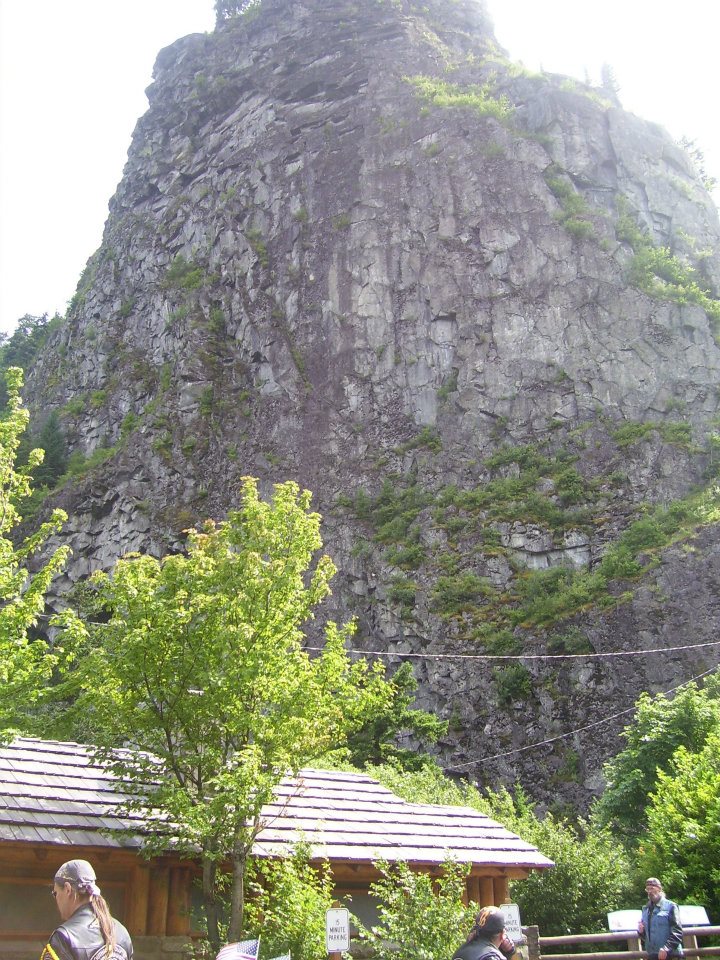
If you don’t want to visit the falls, simply turn right when you reach the junction of the “90 Road” and Curly Creek Road.  This road was built around the turn of the millennium and I have always said that whoever laid it out must have been a biker.  The road climbs with a long left-handed sweeper that swings up the hill before the road wraps around past McClellan Overlook.  By this time the curves have begun to tighten and soon take on a sweet rhythm that feels so natural to a rider to make almost effortlessly.  This section of Curly Creek Road is one of my favorite roads to ride, and it soon passes by too quickly.  At the junction of Curly Creek Rd and Meadow Creek Rd (FR30) turn right and continue on.  The road will swing to the southeast and become Wind River Road.  You will be following this road all the way into Carson and the junction with State Road 14 along the Columbia River. 


Beacon Rock State Park on State Road 14
Turning right onto SR-14 you can follow this wonderful road through the green portion of the Columbia River Gorge all the way back to Camas and State Road 500.  If you don’t make any stops and don’t take any little side-trips, this route will take you a little over three hours to make the complete loop.  I haven’t mentioned most of the camping options along the way, simply because there are so many.  They can easily be found by going to the Gifford Pinchot National Forests website page for camping & cabins, or going to www.recreation.gov and finding great deals on campsites and cabins run by the US government.

I hope you enjoy this route.  It is one of my favorites.  After you have had the chance to check it out, let me know what you think.  I am always open to critiques if they are constructive and mean that I can improve my information to the motorcycling community here in the Pacific Northwest.

Catch you on the road sometime…


Sunday, March 8, 2020

Spring Is Almost Here.


It is that time of year again.  When the frost is finally leaving the roadways and the snow is turning to rain with sun breaks.  The flowers and blossoms are beginning to be seen, and motorcyclist seem to come out of the woodwork.

The time of year when riders are beginning to spend more time creating reasons to ride and not drive.  When the bikes are getting gone over and awakened from their winter slumber.  Tires and other necessary items are being budgeted for and put on the bike.  The end of winter maintenance rituals we all seem to have been getting done.  If they haven't already been completed.

If you are reading this, then the odds are pretty good you are a motorcycle rider or passenger.  This is the time of year that you begin to really look forward to spending more time in the wind with your friends who ride. Whether it means throwing a get together so everyone can get a few miles worth of riding in, or sitting down and planning for a major ride later in the year.  You've probably already made plans to get together and ride somewhere.  

I hope that everyone has had the chance to get the final work done so they can ride without mechanical issues this year.  This looks to be an interesting year, and hopefully one that we can all enjoy riding in a diverse range of places and groups of riders.  And for those who prefer to ride alone, or with just one or two other bikes, I hope you find some great roads to enjoy, that will bring you to some lifelong memories.  Even a ride in nasty weather can bring with it great memories.  After all, here in the Pacific North "Wet" if you don't ride in the rain you don't get to ride a whole lot.

There are man wonderful places to ride to, and some incredible roads to ride in the region.  I hope you are able to enjoy them and can enjoy the thrill of riding through the amazing landscapes our region has to offer.  Who knows, maybe we will even be able to share some road together this year.  I hope so.  

Catch ya on the road sometime...


A Facebook Page and Other Changes


As the next step in rejuvenating the blog after dealing with the life-altering changes I have gone through in the past year and a half, I will be making changes to this blog.  Not so much in content, but in how it is published and/or promulgated.  I have started a Facebook page for the blog, and I am considering releasing YouTube videos related to the motorcycle community.  Some of which I hope to be simple sit-downs with riders to discuss issues before our community.

It's time I stepped back up and started getting back into life again.  But one thing is for sure; I am not going to give up the fight to bring motorcycles into public transportation policy planning more comprehensibly than it is currently.  Which is basically; ignored, exempted, and barely tolerated.

I will be trying my best to highlight some of the good people in our diverse two-wheeled community.  As well as highlighting some local events and issues I feel would be fun, and/or important for our community to take notice of and take part in.

Let's get this thing rolling again.

Catch you on the road sometime...