8 Ball In The Wind

Wednesday, August 27, 2014
Unequal Rights Under The Law
Washington state is a leader in the arena of civil rights. We are proud of our laws to protect the individuals right; to privacy, to use medical and recreational marijauna, to same sex marriage, to be free from social 'profiling', and more. Yet we continue to deny motorcyclists the basic right to choose for themselves what is the proper level of protection while riding a motorcycle. Why?
One of the things that has always seems so odd to me about the governments claim of the 'public burden' motorcyclists are to society when injured after a crash, is the vastly more burdensome effects of other activities that the government condones. In Washington state (according to the CDC) motorcyclists traumatic medical expenses are only 14% of all such expenses. While 69% of that 'burden' comes from occupants of automobiles and light trucks. Yet we don't hear about the soccer moms medical expenses being a public burden.
Both alcohol and tobacco have a much greater impact financially on society than motorcyclists who do not wear a helmet. Yet there are no real efforts to eliminate those risks to health because it is considered an individuals right to smoke or drink. The mind set seems to be, if you consume alcohol or smoke, you are basically only hurting yourself. Unless your doing so affects others in a negative way, you have the right to drink and smoke, and law enforcement will leave you alone.
Obviously, it is not the risky behavior that is what the government is trying to limit. Or the ill effects of such risky behavior. If it truly was, there would be a much more strident effort to restrict drinking, smoking, and illicit drug use than there is. Here in Washington, it is illegal to smoke a cigarette inside a bar, or other public building. To legally smoke a cigarette in public, you have to be more than 25 feet from a door or window that can be opened. While this may make it somewhat inconvenient to have a smoke while you are at the bar, it doesn't alter the your risk while doing so.
But that is just what happens when motorcyclists are forced to wear helmets. The concept is that if you crash, the helmet helps to reduce the risk of brain injury. According to some studies, it may actually depend on the style of helmet whether your risk of traumatic brain injury decreases or increases. If you wear a "full face" helmet with a 'rigid' face bar, you are actually at a higher risk of skull fracture and fatal brain injury than with other types of helmets. However that isnt part of the testing for a DOT helmet. So these helmets that have actually been shown to carry with them a markedly higher rate of fatal skull fractures and brain injuries are perfectly compliant with DOT standards.
The government does not mandate that helmets be able to survive impacts of more than 13.4 MPH. That's the speed a helmet reaches while falling from 6 feet. That is the highest speed that DOT mandates a helmet to be able to withstand. It is widely acknowledged, even by experts and authors of many of the major studies on the subject, that as helmet impact speeds increase their effectiveness decreases. Also, as impact speeds begin to exceed 13.4 mph, the motorcyclist becomes ever more greatly at risk for neck and spinal injuries.
The people who choose to smoke cigarettes or consume alcohol causing severe and long term damage to their bodies by doing so, are not forced by the state to use devices that would reduce the damage caused by their risky behavior. Yet motorcyclists are forced to wear a unnatural weight on their head that the government admits is only 37% effective. This same device upon the heads of motorcyclists has been shown to be a key factor in both traumatic skull and neck injuries during crashes. So whay are we forced to wear them?
This unequal treatment under law would seem to violate the 14th Amendment of the US Constitution. By mandating that one group must forego their right to decide for themselves what risks are acceptable, while not doing so for a much larger group in society is not equal justice under the law. By applying the 'public burden' argument to motorcyclists; forcing us to wear devices that have been shown to be only marginally effective and have a high testing failure rate, while the government allows the larger groups risky behavior to be a far greater burden to society without violating those individuals rights to partake in that risky behavior, the government continues to violate the Civil Rights of motorcyclists in the state.
Motorcycling is an inherently dangerous activity, or so the government would have you believe. So dangerous in fact, that the rights of the individual motorcyclists in the state must be disregarded, and all of them forced to wear a device that can just as easily cause death and injury as protect them. The basic right of a person to be able to decide for themselves whether they feel comfortable with the possible risks the helmet carries with it in relationship to the possible benefits of using it has been stripped by the state.
This is a question of civil liberties. Does an individual have the right to choose for themselves what risks they wish to take with their own bodies? Does an individual have the right to choose the level of protection they feel is proper for their activity? Or, does the State have the right to mandate the individuals choices for self-protection, even if the individual finds that mandate to be ineffective or possibly harmful?
Does the State have the right to inflict its committee established concept of 'acceptable risk' upon its individual citizens? Does the State have the right to claim it is only denying certain individuals rights under the premise of "social burden", while doing nothing to restrict others who have a markedly greater level of "burden" to the state? If the answer is no, than I beg you to support the efforts to repeal the 'mandatory' helmet law in Washington state. Give the individual back the right to decide for themselves the level of risk they are willing to accept for themselves each time they go for a ride. That doesn't mean motorcyclists have to stop wearing helmets. It only means we get to decide when and where to wear them, or not.
Catch you on the road sometime...


Friday, August 15, 2014
A "Safer" Crash?
Ever since the Washington State legislature instituted the mandatory helmet law back in the early 90's, people have been trying to fight it. With a generation of motorcyclists in this state never knowing the choice of being able to wear one or not. They have never experienced the freedom to choose for themselves whether or not they wanted to risk spinal injury for a lower chance of brain injury. Where do I get off saying motorcyclists have to make such a choice? That comes from listening. Listening to helmet manufacturers, bureaucrats, researchers, and doctors. Then looking at what they say, and comparing it to available evidence.
Like it or not, there is significant statistical data that shows wearing a motorcycle helmet lessens the risk of head injury. But then, studies also show that it depends on; impact speeds, type of impact, type of helmet worn. Among other factors contributing to motorcyclists crashing. Which, if you think about it, is the key to the whole argument. If you don't crash, whether you wear a helmet or not is a moot point.
Studies have shown, that as impact speeds rise above 13.4 mph, the risk of neck injury increases. While that helmet may protect your brain at that speed, or even slightly higher, you become much more at risk of severe neck injury. I find it ironic that the neck injury/head injury trade-off comes at the same point of impact speeds that helmets are tested to withstand. But then, even the helmet manufacturers admit that if their helmets pass the two 13.4 mph impacts required in DOT testing, they MIGHT be able to withstand a single impact of about 19mph. "Certainly no more than 23 mph." according to one of the manufacturers. So, I guess that means that above those impact speeds, if you survive, it comes down to luck.
Here agains, the governments concern that we make crashing as "Safe" as possible by wearing helmets that meet the minium manufacturing standards of FMVSS-218 comes into question. Studies have shown that wearing a DOT compliant full face helmet, with a rigid face plate, actually signifcantly increases your risk of fatal fracturing of the side and back of the skull, as well as a more significant risk of traumatic brain injury when you impact the face bar hard enough. However, an open faced helmet, or a full face helmet with a flexible face plate actually lowers your risk of skull fractures AND traumatic brain injury (but you are more likely to suffer major facial fractures). So if you are wearing the wrong DOT compliant helmet in a crash, you are more likely to die because of it.
The governments stated policy is to make crashes "safer". That is part of the problem right there. The governments paternalistic desire to protect its citizens from their own behavior. There is an assumption on the part of the government that all motorcyclists will crash eventually. While I can partly agree with that concept, I wouldn't make it the basis for policy. Especially when that basis concludes that learning to avoid a crash is a less desirable measure than having a "safer" crash.
There is no such thing as a "safe" crash. I have been in a few crashes since I first began to ride back in the 1970's. The only way any of them could be considered "safe" crashes was the fact I was able to walk away from them. Crashing isn't "safe". Webster defines a crash as; "To fall, land, or hit with destructive force." Somehow, I just can't 'destructive force' and 'safe'. To me, the only "safe" crash, is the one you don't have.
Catch you on the road sometime...
Thursday, August 7, 2014
Motorcycle Helmets...37% Effective
I've been trying to get my head around a few things relating to this whole helmet issue. The trouble is, the more I look into it, the more I oppose mandatory helmet laws. Simply put, the facts used by the regulators and mandators, just doesn't make logical sense to me.
For one thing, NHTSA proudly proclaims that motorcycle helmets are 37% effective. With an effective rating that low, I surely wouldn't be boasting about it. If it was 73%, I could almost go along with being proud of the numbers. But I would be ashamed of an effectiveness of only 37%. Wouldn't you?
Then, there is the impact tests that helmets must be able to withstand in order to comply with FMVSS-218. Helmets must be able to withstand two impacts. The average speed of impact needed to meet the standard is 13.4 MPH. The height the helmet is dropped, or conversely the anvil is dropped, is 6 feet. So, basically the same distance as if I fall down wearing my helmet. The only problem with that is, the leading contributing factor in motorcycle crashes is speeding. So if your helmet can withstand an impact at 13.4 MPH, how does it fair at 70, or 80 MPH? The manufacturers claim that it is highly unlikely that a motorcyclist will have a head-on impact with a solid object during a crash at or above freeway speeds. I'm not sure I buy into that. When you add into the mix that between 1980 and 2008, fully 61% of helmets tested FAILED, do we really want these things mandated to be worn? Even Professor Harry Hurt, author of the famous Hurt Study stated during an interview in 1992 that: "When impact speeds get to be 25-30 MPH, there isn't a helmet in the world that's gonna save you." That is coming from one of the leading proponents of motorcycle helmet laws.
I also looked at a study comparing facial injuries and skull fractures in fatal motorcycle accidents. According to this study, there is a higher degree of fatal skull fractures amongst injured motorcyclists wearing full face helmets with a rigid face guard than those wearing a full face helmet with a flexible face guard, or an open face helmet. Although, while the wearers of the last two types of helmets have a significantly higher rate of facial fractures they have a higher survival rate than those wearing a rigid face guard full face helmet, their rate of brain injuries is lower. As is the rate of fatal skull fractures.
So what do we have here? The government proudly proclaims helmets to be 37% effective in saving lives. Helmets must be able to withstand two thumps of 13.4 MPH to withstand the impact test. So in theory at any rate, it might be able to withstand a single impact slightly higher. Only about 39% of helmets are historically shown to pass testing since 1980. And, some types of helmets are more likely to cause a fatal skull fracture because of their design.
But what really has me not wanting to be forced to wear a helmet, is the fact that NHTSA admits without any qualms that manufacturers are the ones who certify their helmets meet the standard. The manufacturer certifies the helmet meets the standard when they apply the DOT label and sticker on the helmet. Now get this, they don't have to test the helmet before certifying it. They simply have to have a good faith belief that the helmet meets or exceeds the requirements of FMVSS-218. If one of the contracted laboratories that does the testing buys that helmet and it fails the test, ONLY THEN does the certification of the helmet end. How many times have you heard of a motorcycle helmet recall? With a 61% failure rate, how many helmets out there being used today aren't able to even meet the minimum standards of testing?
Then to top it off, a helmet should be replaced after 3 to 5 years of use. Depending on how often it is used. Because as it wears to the shape of your head, it becomes less effective until it is so ineffective after 3 years that it requires replacement. So, if that helmet is only 37% effective when it is new, how effective is it after 3 years? Would you really be satisfied being forced to wear an impact reduction device that is only 37% effective? Think about that, and answer it for yourselves.
Catch you on the road sometime...
Friday, July 25, 2014
Numbers Game
I have been going over motorcycle reports and studies as part of my duties as Legislative Affairs Officer for the Elk Country Chapter of A.B.A.T.E. of Washington. If it wasn't such a serious subject, I would almost find it amusing how several of the key studies that are used to foist the Federal governments desire for a universal mandatory helmet law for motorcyclists on the riding public. As is typical of many statistical studies, it depends on what variables you choose to compare as to whether you will get the results you desire. Let's be honest about this, if you are putting in the effort to do a statistical study of whether helmets are effective or not, you probably already have a point of view you want to demonstrate is correct with your statistics. Government agencies are no different. Except maybe in the fact that they want their statistics to support the rules and regulations they themselves create and promulgate throughout the country.
Take for example, the CDC. Somewhere along the way, the bureaucrats at CDC decided that their sphere of power and influence went beyond 'disease control' into all areas of health and safety. Any area that they felt had some connection to being able to affect the life and death of citizens. Being the good bureaucrats they were, they decided to look into the 'effectiveness' of mandatory helmet laws. Several studies had shown a significant reduction in the rate of head injury when wearing a helmet during a crash. CDC ran their own study back in 1990 comparing the fatality rates in mandatory and voluntary helmet use states between 1979 and 1986. What they did was actually come up with two separate rates for head related deaths from motorcycle accidents. One, showed virtually no significant difference between the two sets of states death rates. The other, showed a significant difference, higher death rates in the voluntary helmet states.
How did they do that, you ask? Well, if you didn't, I did. What they did was divided the number of head injury fatalities associated with motorcycle crashes by the states population (Voluntary helmet states tend to be a bit more rural, and have lower populations. So changes in the fatality rates divided by a smaller population would show a larger change). As a result, they came to a finding that the death rates in voluntary states were nearly double that of mandatory states (An average of 11.4 fatalities per million in voluntary helmet use states. Compared to an average of 5.5 per million in the mandatory use states.)
The CDC study also divided the head injury fatalities of motorcyclists by the number of motorcycle registrations in each state. The numbers came back looking quite different. There was virtually no significant difference between the two sets of states (An average of 3.5 fatalites per 10,000 registered motorcycles in the voluntary states compared to an average of 3.0 fatalities per 10,000 registers motorcycles in the mandatory states. That is only a difference of 0.005%.) Since the CDC is so adamant about motorcyclists wearing helmets to prevent head injuries and dying from them in crashes, they used the population based rate which gave them the more dramatic differences to 'prove' their conviction that all motorcyclists should be mandated to wear helmets.
To further demonstrate how blindly the CDC is devoted to mandatory helmet laws, Congressman Thomas Petri wrote the CDC asking why they were involving themselves in the effort for a national universal helmet law. In a response, dated January 27, 2014 the CDC stated that; "CDC approaches motorcycle safety in the same manner as other public health issues, such as heart disease, cancer, and asthma." The letter went on to state that in 2010, 41% of fatalities on motorcycles were not wearing helmets. Followed by a paragraph on how helmets can reduce the life long costs of even non-fatal head injuries.
I do not argue with the contention that motorcycle helmets have been shown to reduce head injuries. However, I also know that studies have shown that the benefits of reduced head injuries begin to trade-off with an increase in the risk of neck injuries above a certain speed. What is that speed? It is in the range of 13mph. Thats about the same speed that FMVSS-218 requires motorcycle helmets to withstand impacts of (13.4mph). So above the speed of about 13mph, the increase in risk of neck injury due to wearing of the helmet would seem, to me anyway to offset the desired effect of the helmet.
Since two of the major contributors to fatal motorcycle accidents are speeding and drug or alcohol impairment (Between 2006 and 2010, 53.3% of motorcycle fatalities had speeding as a contributing factor. While 53.7% had drug or alcohol impairment as a factor. No doubt many had a combined influence.), the real world speeds of fatal crashes tend to be more than a tad higher than 13.4 mph. But that is a fact very few studies seem to make known. While at low speeds, a helmet will more than likely protect you from head injury in a crash, after about 13 mph you become ever more at risk of severe neck injuries.
One of the most famous and influlential studies of the 20th Century on traffic and motorcycle safety, and the benefit of helmets was no doubt, the Hurt Report. Authored by Professor Harry Hurt, it is still regarded as one of the best arguments for mandatory helmet laws ever produced. During a 1992 television interview, Professor Hurt made a comment I don't think would sit well with many if not most of the safetycrats in our government today. He said simply; "When impact speeds get up to 25-30 mph, there's no helmet in the world going to save you."
With that thought, I'll bid you all a fond 'adieu', and let you ponder the governments numbers game.
Catch you on the road sometime...
Take for example, the CDC. Somewhere along the way, the bureaucrats at CDC decided that their sphere of power and influence went beyond 'disease control' into all areas of health and safety. Any area that they felt had some connection to being able to affect the life and death of citizens. Being the good bureaucrats they were, they decided to look into the 'effectiveness' of mandatory helmet laws. Several studies had shown a significant reduction in the rate of head injury when wearing a helmet during a crash. CDC ran their own study back in 1990 comparing the fatality rates in mandatory and voluntary helmet use states between 1979 and 1986. What they did was actually come up with two separate rates for head related deaths from motorcycle accidents. One, showed virtually no significant difference between the two sets of states death rates. The other, showed a significant difference, higher death rates in the voluntary helmet states.
How did they do that, you ask? Well, if you didn't, I did. What they did was divided the number of head injury fatalities associated with motorcycle crashes by the states population (Voluntary helmet states tend to be a bit more rural, and have lower populations. So changes in the fatality rates divided by a smaller population would show a larger change). As a result, they came to a finding that the death rates in voluntary states were nearly double that of mandatory states (An average of 11.4 fatalities per million in voluntary helmet use states. Compared to an average of 5.5 per million in the mandatory use states.)
The CDC study also divided the head injury fatalities of motorcyclists by the number of motorcycle registrations in each state. The numbers came back looking quite different. There was virtually no significant difference between the two sets of states (An average of 3.5 fatalites per 10,000 registered motorcycles in the voluntary states compared to an average of 3.0 fatalities per 10,000 registers motorcycles in the mandatory states. That is only a difference of 0.005%.) Since the CDC is so adamant about motorcyclists wearing helmets to prevent head injuries and dying from them in crashes, they used the population based rate which gave them the more dramatic differences to 'prove' their conviction that all motorcyclists should be mandated to wear helmets.
To further demonstrate how blindly the CDC is devoted to mandatory helmet laws, Congressman Thomas Petri wrote the CDC asking why they were involving themselves in the effort for a national universal helmet law. In a response, dated January 27, 2014 the CDC stated that; "CDC approaches motorcycle safety in the same manner as other public health issues, such as heart disease, cancer, and asthma." The letter went on to state that in 2010, 41% of fatalities on motorcycles were not wearing helmets. Followed by a paragraph on how helmets can reduce the life long costs of even non-fatal head injuries.
I do not argue with the contention that motorcycle helmets have been shown to reduce head injuries. However, I also know that studies have shown that the benefits of reduced head injuries begin to trade-off with an increase in the risk of neck injuries above a certain speed. What is that speed? It is in the range of 13mph. Thats about the same speed that FMVSS-218 requires motorcycle helmets to withstand impacts of (13.4mph). So above the speed of about 13mph, the increase in risk of neck injury due to wearing of the helmet would seem, to me anyway to offset the desired effect of the helmet.
Since two of the major contributors to fatal motorcycle accidents are speeding and drug or alcohol impairment (Between 2006 and 2010, 53.3% of motorcycle fatalities had speeding as a contributing factor. While 53.7% had drug or alcohol impairment as a factor. No doubt many had a combined influence.), the real world speeds of fatal crashes tend to be more than a tad higher than 13.4 mph. But that is a fact very few studies seem to make known. While at low speeds, a helmet will more than likely protect you from head injury in a crash, after about 13 mph you become ever more at risk of severe neck injuries.
One of the most famous and influlential studies of the 20th Century on traffic and motorcycle safety, and the benefit of helmets was no doubt, the Hurt Report. Authored by Professor Harry Hurt, it is still regarded as one of the best arguments for mandatory helmet laws ever produced. During a 1992 television interview, Professor Hurt made a comment I don't think would sit well with many if not most of the safetycrats in our government today. He said simply; "When impact speeds get up to 25-30 mph, there's no helmet in the world going to save you."
With that thought, I'll bid you all a fond 'adieu', and let you ponder the governments numbers game.
Catch you on the road sometime...
A Deadly Helmet?
With all the research I have been doing of late into this entire helmet issue, one of the things that surprised me was a study by a couple of high ranking Dr.'s in Australia. At first, I thought it was going to be a report on how "effective" helmets were. Man, was I wrong. If you get a chance, check it out yourself. It is available online (for free I might add), and is called; "Motorcyclist Craniofacial Injury Patterns" by Drs. Cooter and David.
What their study is about is helmets and head injuries. It splits itself into two groups. Those with survivable head injuries, and those with fatal head injuries. All of who were wearing helmets. The ones wearing open face, or full face helmets with flexible face-bars, received extensive facial fractures. BUT, (and this is a pretty big "but") a significantly lower rate of brain injury.
The motorcyclists who were wearing full face helmets with rigid face bars, however, showed a much lower rate of facial fractures. BUT, (and this is another big "but") they had a MUCH greater rate of fatal skull fractures, and fatal brain injury.
Basically, the rigid face bar, which is connected to the chin strap, imparts the impact force through the chin strap forcing the base of the skull to fracture. In a very similar manner as to when a hangmans noose is placed under a persons jaw when they are hanged. The brain damage due to this sort of fracture tends to be extreme and fatal. So while the rigid face bar of the helmet protects your face from being shattered, it has a much higher rate of killing you by ripping your brain apart.
Apparently, the more flexible face bars, and open face helmets, allow your facial bones to shatter. However, the fracturing of your face, while EXTREMELY painful, spreads out and absorbs much of the impact force. Leaving your brain with a greatly reduced risk of damage.
Don't believe me? Check it out for yourself. If you have to wear a helmet when you ride, it may just give you something to think about when you buy your next one.
Catch you on the road sometime...
Thursday, July 24, 2014
I'm Back!!
Well here I am, back from several days on the bike. Spent some time with some good people, and got to meet a few more face to face for the first time. It wasn't without some drama, but all of the motorcycle kind. Two different bikes, both developed oil leaks, and both "broke down" within a couple of blocks of each other. Whats even better, both riders ran into each other at the same auto parts store.
Typical Columbia River Gorge weather in July...hot and windy. With several small fires in the area, everythying was pretty tense when it came to fire. So no campfires at night, or even burning charcoal briquets. So cooking had to be done on the old campstoves. The gusting 50mph headwinds heading west through the gorge for about 40 miles or so were a pain in the ass, but otherwise I had a Hell of a good time.
Got a few decent pics, too many to post all of them. But here is a few, just to give you an idea of the fun. I'll be back to focussing on the helmet issue, and any other issues that get my goat from here on. But for now, enjoy.


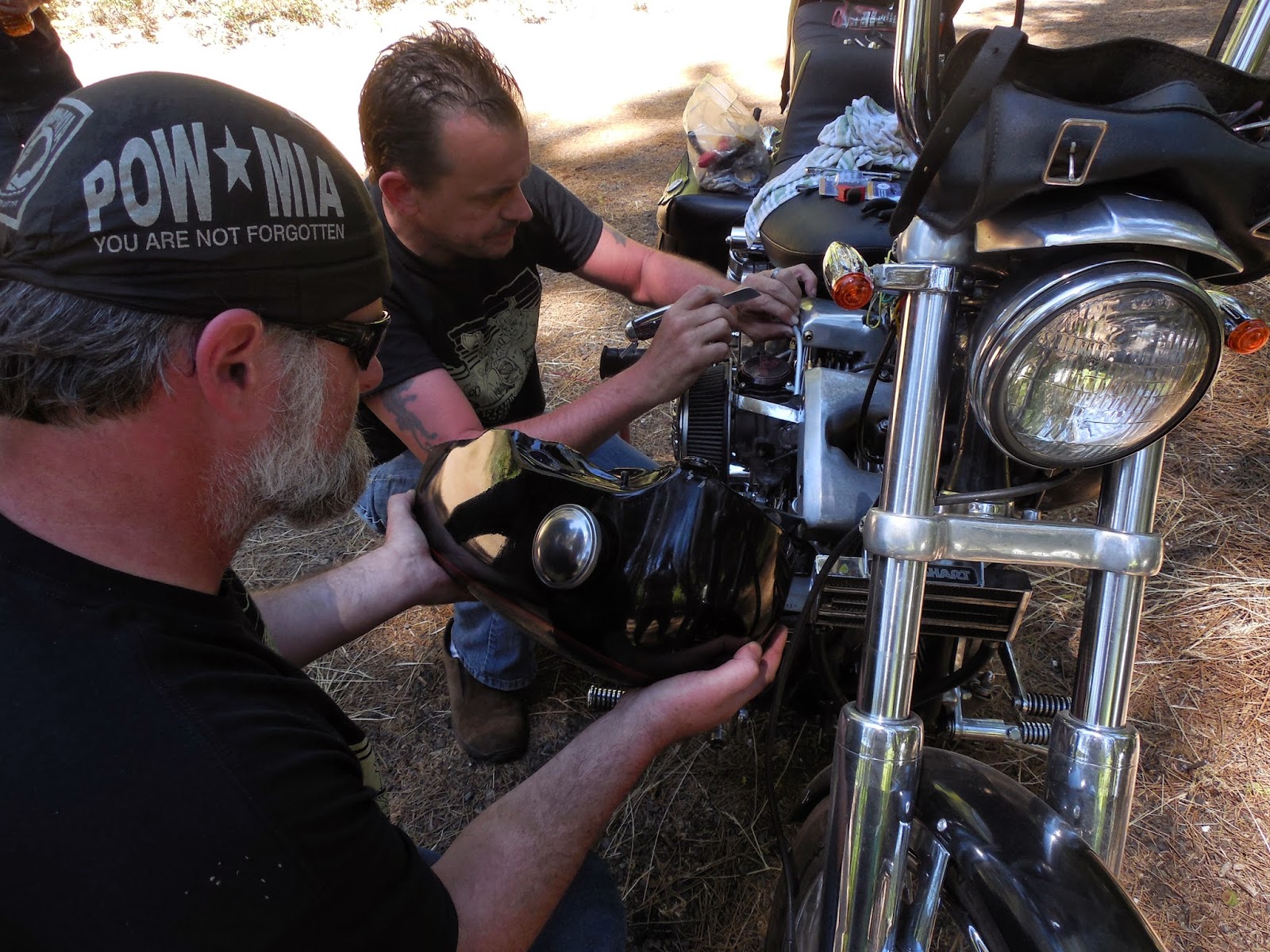

Catch ya on the road sometime...
Wednesday, July 16, 2014
ROAD TRIP!!

I'll be heading out on a road trip/camping trip with some friends, and their "Garage Built, Sportster Powered, Death Traps" for a few days. Heading over to eastern Washington as a base, and riding out from there. So needless to say, I won't be posting any blogs for a few days. Have a good time everyone, and I'll be back after I roll home again.
Catch you on the road sometime...
Subscribe to:
Posts (Atom)