8 Ball In The Wind

Thursday, March 30, 2017
Bizarre Differences In Governor's Highway Safety Association Fatality Reports
According to the 2017 preliminary report on pedestrian fatalities on American roadways; pedestrians now account for the largest proportion of traffic fatalities in the US. In 2015, pedestrians had accounted for 15% of highway fatalities. The preliminary estimates for 2016 indicate pedestrians may account for a full 16%. This is an even higher percentage than motorcycle fatalities, which hover at 14% of total fatalities.
When you compare the Governor's Highway Safety Association reports for pedestrian and motorcyclists, there is a shocking difference in the basic mind-set of the reports. For example on the 'Introduction' page of the pedestrian report it reads; "Walking is the oldest, most basic, and arguably the most beneficial form of human transportation. Walking provides many important personal and societal benefits." Now compare that glowing first few sentences on walking in the pedestrian fatality report, to the first few sentences of the motorcycle fatality report; "Motorcycles are less stable than four-wheeled vehicles and lack protective vehicle structure to minimize injuries when crashes occur. The result is substantially higher fatality rates for motorcyclists, whether based on registered vehicles or miles driven." Sounds like motorcyclists are in quite substantial danger, doesn't it? Yet the pedestrians account for a greater percentage of fatalities than motorcyclists do. What is the explanation for that?
Part of it could lie in the governments not so hidden agenda. The entire 'Introduction' page of the 2016 Motorcycle report is about the high risk of fatality. While the newly released report on pedestrians in 2016 has an 'Introduction' page that talks about; reducing traffic congestion, the high cost of operating a car for a year, reducing greenhouse gases by walking, and the benefits of public transit to various demographic groups. Not once on that page is there even a hint of anything dangerous, or fatal. Not the slightest hint of anything but a glowing review of the benefits of walking. Which seems rather strange considering approximately 1,500 more pedestrians were killed on US roadways than motorcyclists in 2016.
Then on page seven of the report is this slightly bizarre statement; "In addition to the role that increased walking may play in the increasing number of pedestrian fatalities as a proportion of total traffic deaths, another factor may be the larger and more consistent declines in occupant fatalities, attributed in part to steady enhancements in vehicle crashworthiness and crash avoidance technology. By contrast, pedestrians remain just as susceptible to sustaining serious or fatal injuries when struck by a motor vehicle." Are they actually comparing car passengers to pedestrians in accidents? As if there are possible "enhancements" for pedestrians?
But then when you look at page seven of the motorcycle report, there is this familiar statement; "In addition to the role that increased motorcycling activity might play in the growing percentage of motorcyclist fatalities as a proportion of total traffic deaths, another factor may be the larger and more consistent declines in occupant fatalities, attributed in part to steady enhancements in vehicle crashworthiness and crash avoidance technology. By contrast, motorcyclists remain just as susceptible
to injuries when involved in a crash." It would seem to make one wonder, just how much critical thinking is going on while preparing these reports when the wording on the same pages is so similar. Could these be simply "form reports" with just different diagrams and charts in place?
Whatever the reason for these seemingly 'cut & paste' reports, it is the differences that seem to be more bizarre. Even though approximately 1,500 more people died walking than riding motorcycles, the two activities are treated in completely opposite tone and tenor of language. For those of you who don't have access to the GHSA reports, I'll leave you with samples of each report. Each sample will be from page five of the relevant report. But look at the difference between how walking in portrayed and how riding a motorcycle is portrayed. You may notice that riding a motorcycle is made to seem extremely dangerous. While walking is a wonderfully healthy, environmentally heroic, economically smart, and public transit linked activity.
First the portions from page five of the motorcycle fatality report; "Per mile driven, fatality rates for motorcyclists were 26 times that of passenger vehicle occupants in 2013 (NHTSA, 2015)." As well as; "Despite their limited presence, motorcycles currently account for nearly 15 percent of all motor vehicle fatalities." Finally this last quote from the same page; "Fatalities began to rise in 1998 and increased by 151 percent (2,116 to 5,312) through 2008. Since then (2009 — 2014), the average annual number of motorcyclist fatalities has been 4,644. During the 1997 — 2014 time frame, motorcyclists’ share of total motor vehicle deaths rose from 5 percent to 14 percent." Note the repetition of "fatalities"?
Now compare that with the same page from the pedestrian fatality report, and from the same page. Both page fives are the 'Introduction' pages of the reports. But the pedestrian fatality report would seem to be getting "introduced" for something entirely different. As you can see here:
"Walking provides many important personal and societal benefits:
●● Health: The Centers for Disease Control and Prevention notes that “walking is a great way to get the physical activity needed to obtain health benefits.” Along with the important benefit of
social engagement, walking can reduce the risk of obesity, heart disease, diabetes, and stroke.
●● Transportation: The 2009 National Household Travel Survey found that 28 percent of trips are less than one mile in length, and 40 percent are less than two miles in length, representing 15-
30 minute walks. Moving from a vehicle to the sidewalk can help reduce congestion.
●● Economic: AAA estimated in 2016 that the cost of operating a car for one year is approximately $8,558, while walking is free.
●● Environmental: According to the U.S. Environmental Protection Agency, motor vehicles are responsible for more than one-half of nitrogen oxide and toxic air pollutant emissions, and
one-half of smog-forming volatile organic compounds. Walking, on the other hand, does not negatively impact the environment.
●● Transit: Walking is intrinsically linked with public transit, which provides a vital alternative to travel by private automobile. Many transit users do not drive cars, including children, older adults, people with disabilities, and the economically disadvantaged. Safe access to transit, including appropriate design and placement of bus stops, is important.
The good news is walking is becoming an increasingly popular mode of transportation. A 2015 report by the Government Accountability Office (GAO) noted that nearly one million more people reported walking or biking to work in 2013 than in 2005."
Did you see "fatalities" even once? Don't get me wrong, I am all for walking, but is it really appropriate to 'sugar coat' a report on pedestrian fatality with how wonderful walking is, while repeatedly emphasizing the risk of fatalities while riding a motorcycle? Don't even get me started on how "walking is intrinsically linked with public transit." That obviously was written by someone who has lived in an area served by public transit, and who has had at least a passing acquaintance with Neuro-Linguistic Programming. So, what are you thoughts on the bizarre differences and similarities of these two reports, and how they affect the way we wish to travel? Let me know what you think. I am curious to hear and learn.
Catch you on the road sometime...


Sunday, March 26, 2017
Lane Sharing Explained Part 3 Countering The Opposition
In the first two parts of this series, I discussed some of the various studies involving lane sharing. With the 2014 and 2015 UC Berkeley Studies, and Dr. J.V. Ouellet's 2011 study being the main focus. In this part of the series I will be discussing some of the opposition I have encountered working on the issue, and what could be used to counter that opposition.

I have encountered many varied facets of opposition. Some of which actually seem less to be about lane sharing as about the perception of appearing interested. The majority have been more disinclined to support the issue either simply because the WSP doesn't support it, or because of technical questions. The latter is a much easier opposition to overcome; simply find and supply the answers in a concise and concrete manner (I didn't say it would be "easy" only "easier"). Countering the WSP's opposition is more difficult, as it is a much more ethereal opposition. I have yet to receive a definite description of why they oppose it. Usually their opposition is expressed in a vague and almost circular way.

Some of the opposition in the Washington State Legislature against lane sharing appears to be caused by a misconception that data was intentionally "cherry picked" to support our positions, while ignoring data that doesn't. However, if the opposition would actually look at the number of studies; done in different years, by different researchers, on different continents, yet still having data that generally conforms might alter that mindset.
Similarly there has been expressed the belief that somehow the studies from the University of California Berkeley somehow used inaccurate data, and additional studies should be done by a university in Washington. The data that was gathered and analyzed by UC Berkeley came directly from collision reports and as part of the study, an additional form completed and submitted only on the data points the study was analyzing. Since lane sharing isn't currently allowed in Washington State, any study done by a Washington university would have to rely on reviewing the same data as Berkeley had. Therefore the only likely significant difference would be that the study was performed by a university in Washington rather than California; and at a significant waste of taxpayer dollars duplicating Berkeley's study no doubt.
 These two facets of the same basic opposition would seem to be generated by a perception that lane sharing is 'dangerous' and maintaining position in traffic is 'safe'. This perception would seem to stem from those in cars, relating to a space their vehicle can in no way fit through. While people in sitting down inside their cars have a reduced field of vision compared to motorcyclists; who sit up higher and having a wider unobstructed field of view, allowing them to perceive the situation in a completely different way.

A motorcyclists needs to be able to take charge of their own immediate safety. Lane sharing allows the motorcyclists to this this. Putting the motorcycling in charge of their own interaction with other vehicles on the road. It is that control that provides motorcyclists with that element of safety. That is why, as shown by the studies we have already looked at, that lane sharing collisions are fewer and less severe than for non-lane sharing motorcycle collisions. With the width of our motorcycles no more than about three feet, there is still close to two feet of clearance on either side of out motorcycle. Think about that, if there was a space on the road half again as wide as the clearance for your car to safely pass through, wouldn't you want to be allowed to move through it if you could in congested traffic? That is all lane sharing is, and why motorcyclists want the option to be able to use that tool to help move safely through traffic. It is the rider who makes the decision whether to proceed into a situation where a crash could occur. Since punishment for a bad decision will be immediate and painful, it is to the riders benefit to make fairly good decisions.
In this way, not only can the motorcyclist select the most advantageous position to continue moving, and by doing so is no longer restricted to a vulnerable position that increases the risk of being seriously injured or killed.

Catch ya on the road sometime...
Lane Sharing Explained Part 2 The Studies

When you look under the "results" on page 2 of the 2014 Berkeley study, you will note that it is compiled from data involving 7,836 motorcyclists. This is a significant sampling, being roughly ten times larger than that of the 1981 'Hurt Report'. The data obtained can be used to better understand the safety benefits of lane sharing. Especially after comparing them to the findings of Dr. Ouellet's 2012 study showing approximately 60% of motorcyclists lane sharing during congested traffic situations. Yet, only 0.6% of motorcycle crashes were related to lane sharing.
 The 2014 Berkeley study shows a significant different in the make-up of motorcyclists in California who lane share. The percentage of unlicensed riders was moderately lower among lane sharing motorcyclists at 18% compared to 22% of all other motorcyclists. The lane sharing motorcyclists were also; less likely to carry a passenger (2%) compared to other motorcyclists (6%), less likely to be rear ended by another vehicle (2,7%) compared to the other motorcyclists (4.6%), less likely to be affected by alcohol (1.3%) compared to other motorcyclists (3.3%). So, the 2014 Berkeley study shows that lane sharing motorcyclists were more likely to be; properly licensed, solo riders, at a lower risk of being rear-ended, as well as being less likely to have consumed alcohol than other motorcyclists who chose not to lane share. These findings conformed well to the 2015 Berkeley study which contained a sampling of 5,969 motorcycle collisions.
Both studies also show a significant difference in the number and severity of injuries received by lane sharing motorcyclists. Injuries to the torso, and head, and fatal injuries were all significantly lower for lane sharing motorcyclists. The differences in both studies conformed to each other extremely well, showing results that generally conform to
2014 Injuries: lane sharing motorcyclists (LSM's) vs non-lane sharing motorcyclists (NLSM's)
- Head injuries LSM's 9.1% NLSM's 16.5%
- Torso injuries LSM's 18.6% NLSM's 27.3%
- Fatal injuries LSM's 1.4% NLSM's 3.1%
2015 Injuries: lane sharing motorcyclists (LSM's) vs non-lane sharing motorcyclists (NLSM's)
- Head Injuries LSM's 9% NLSM's 17%
- Torso injuries LSM's 19% NLSM's 29%
- Fatal injuries LSM's 1.2% NLSM's 3%
Both studies indicate that lane sharing motorcyclists tend to be better equipped, solo riders during commute hours, traveling at lower speeds. While there are a segment of riders who travel at a higher speed differential, most travel at lower speeds in relation to the flow of traffic. With the overall lane sharing activity beginning to drop of sharply between 35 & 40 mph.
I would strongly suggest that you follow the links in this blog post, and read the studies for yourself. If lane sharing is to become an option in Washington State, then the motorcycling community needs to become better informed on the facts, and able to counter arguments that opponents may bring forward. I'll discuss some of those arguments in the final part of this three part series.
Catch ya on the road sometime...
Saturday, March 25, 2017
Lane Sharing Explained Part 1 An Introduction
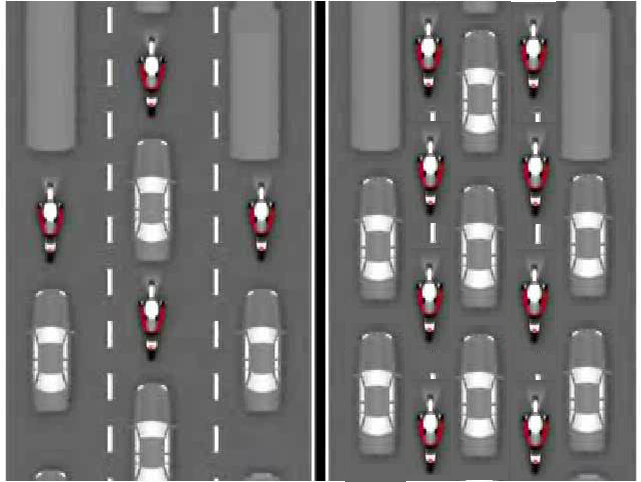
 It seems as if, even when presented with the studies showing the effectiveness of lane sharing, some legislators and others simply refuse to believe it. So I am taking this time to explain the practice in as simple a way as I can. All while including ample supporting information. Not so much in the belief that it will be sufficient to convince everyone, but to at least give them references to research and discover the truth for themselves.
 Riding a motorcycle is an inherently dangerous thing. Riders don't have 'crumple zones', we have perhaps some leather to protect us. It is up to the rider to take control of our own safety. After all, it is the rider that must pay the inevitable price for our actions, not some lawmaker. By taking control of our own actions and options for moving through traffic, motorcyclists can help insure our own protection in the moment. In the end, it is our own riding skills that we must rely on to protect ourselves. We have to be constantly vigilant for the actions of other drivers that could lead to our injury or death. This is just one of the reasons I am an active proponent of lane sharing on Washington State's highways.
 In 2011, Dr. J.V. Ouellet, a co-author of what has been called the most in-depth study on motorcycle traffic safety of the 20th Century, the Hurt Study, published a study entitled "Lane Splitting on California Freeways". In this study, among other things, the data from the Hurt Report was compared to new research performed by Dr. Ouellet's team. It was found that the conditions under which lane sharing occur conformed quite closely to that from the late 1970's. Dr. Ouellet also found that lane sharing activity decreased as freeway traffic speeds increase. With a quite definite decrease above 40 mph. Also, motorcycle crashes involving lane sharing account for a very small number (less than 1%) of all motorcycle crashes. In the 1970's research for the Hurt Report only 0.6% of motorcycle crashes involved lane sharing. In the European report MAIDS (Motorcycle Accident In-Depth Study) which studied crashes in Europe during 1999-2000 the percentage of lane sharing involved crashes was only 0.4%.
  One of the prime arguments many of those who oppose lane sharing is the risk of the motorcyclists being hit by a vehicle that suddenly changes lane in front of the motorcycle. The following is a quote from Dr. Ouellet's study that addresses that concern directly. "The risk that a car might change into the motorcycle's path does not disappear when the rider is maintaining a normal position. Most motorcycle/car crashes occur when a car driver fails to see a motorcycle, and making an unsafe lane change after failing to see a motorcycle in an adjacent lane is just another variation on the common problem. In addition to the risk of a lane-change crash, motorcyclists in a normal lane position face the risk of a rear-end collision, with the motorcycle striking the rear of the vehicle ahead or being struck from behind by a vehicle following it too closely."
 A rider maintaining normal lane position has little or no ability to affect whether a car in an adjacent lane will intrude into the motorcycle's space. The motorcyclist is entirely reliant on the car drivers's vigilance and judgement. A vulnerability that strikes the very heart of the great majority of motorcycle/car crashes.
To put it simply, data suggests that lane sharing may be safer than NOT lane sharing. If this finding is valid, then laws restricting and effectively banning lane sharing could easily be having the unintended result of increasing the risk of motorcycle crashes. Thereby increasing the risk of serious injury or death. Consider it objectively and see what you think. I'll be covering the 2014 & 2015 University of California Berkeley studies on the practice in an upcoming post, so keep your eyes open for it.

Catch ya on the road sometime...
Wednesday, March 22, 2017
Some House Transportation Committee Members Upset With Aggressive Tactics Of Bikers
As the motorcycling community has tried to apply pressure to achieve the goal of a public hearing on the lane sharing bill in the House Transportation Committee, some members of the committee found the email requests of some members of the community to be aggressive, bordering on threatening. There is no place in the political process for the use of threats or malicious emails. They tend to have the exact opposite effect that is desired. Only pissing off the person receiving them. That is why, even if you disagree, it is still a good idea to be diplomatic and respectful when communicating with legislators. Think about it, if someone disrespects you in a message, are you likely to do something they are asking you to do? I think not. So I have to ask if anyone did get nasty or disrespectful, did you get the reaction you wanted?
There were even reports of a website created to attack Rep. Clibborn on this issue, as I was informed by the Assistant Majority Whip during a brief discussion outside the capitol on Monday (March 20th). He made sure that I had understood how upset many of the legislators were about this. Besides numerous comments and posts on Facebook, this blog seems to be the only other online site speaking out on this issue. However, as you can easily discover by looking at the archives, this blog has been running since 2010, and has only made a handful of reports on this issue, and yes, those have been in the past week or so. But I have tried not to be disrespectful, only pointing out the facts as I know them. I would hope this blog is not considered a weapon to attack individuals, but to express my opinion on things I am involved in.
Whether good or bad, the issue of Lane Sharing is getting talked about in the legislature. Sadly, the talk seems to be more about an aggressive challenge to one of their own than the merits of the bill. That talk is causing concern to many. Including supporters of the motorcycle community. Even the Chair of the Senate Transportation Committee expressed concerns that needed to be allayed. I am only partially sure my telling him that it was specifically stated to be "polite" when making emails or calls regarding the bill actually eased his concerns.
One of the worst things that can happen to our efforts in Olympia is for our respect and support among legislators to shrink due to the effect of a few individuals who allowed their zeal to overtake their common sense and civility. Unless someone is out to unintentionally sabotage the efforts of the motorcyclists of Washington, I would hope that no one would make aggressive or threatening emails in an emotional release as they typed.
As I have previously posted, The Chair of the House Transportation Committee has not, and is unlikely to call a public hearing on SSB5378 (The Lane Sharing Bill) prior to the cut-off for bills from the opposite chamber to pass out of committee this session. When asked to hold a hearing last week the Chair simply repeated that it wasn't "my fault" but there wasn't going to be a hearing. While she does have the final say on whether or not to hold a hearing, it now seems that the Chair was possibly trying to show loyalty in not stating why she wouldn't. She apparently wished to do the honorable thing towards some members of her committee, and not 'throw them under the bus'. However, this week I have been informed face to face by at least one committee member who had said they would speak to the Chair request a hearing, but now wanted to "clear the air", saying that she had "lied" about requesting a hearing from the Chair. While it is a shame that happened, the fact that she had opposed the bill to begin with had always caused me to accept her statement that she would request a hearing with a grain of salt. While it would have been nice if she had, it would also have been quite surprising.
Personally, I feel it would have caused much less confusion, and still not thrown anyone 'under the bus' if Rep. Clibborn simply said that she didn't believe there were enough votes in favor of the bill to warrant a hearing. But using absolutes; such as "everyone" and "no one" lessened her credibility. Especially after changing her story as she did on discussing the bill with Capt. Alexander of the WSP over a period of just a minute or two during our meeting. However, in the long run, I doubt it would have changed things much. Although hopefully there would have been less hard feelings all around.
The support for 5378 is spreading among motorcyclists. There is even at this late date an effort to hold another protest at the capitol on this Friday (March 24th) that is not an ABATE sponsored protest. I take that as a sign of broader support for the technique. As well as an opportunity to build a foundation on which a broad based effort can be made to educate legislators in the congestion relief and safety benefits of lane sharing on Washington's highways. If we can properly educate enough legislators, than this can continue to roll forward. It just needs to be done with mutual respect and honesty.
Catch you on the road sometime...
Bikers Protest In Support Of Lane Sharing BIll
 On Friday, March 17th, bikers from across the state endured the cold and rainy weather and journeyed to Olympia to protest the decision not to hold a hearing on SSB5378 (The Lane Sharing Bill). In just over two days, the protest went from an idea to being implemented. Gathering around the circle around the sundial between the House and Senate offices, bikers peacefully showed their support for a hearing. The threatening rain held off, and local television new media (KIRO 7 & KING 5) were there to cover the protest.


With the cut-off date for it to pass out of committee now only days away, the fight will have to move on to the interim period. Using that time to educate legislators on the effect of the bill, and the safety benefits of lane sharing. It's going to continue to be an uphill fight, but we are making progress.
Catch you on the road sometime...
Sunday, March 19, 2017
Bias Shown In Statements By Committee Chair
 |
| Washington State House Democrats member Judy Clibborn web page banner |
Apparently Rep. Clibborn also feels that motorcyclists have all "misinterpreted the studies" showing the benefits of lane sharing. She stated that there are "no safety benefits of lane splitting." Which would seem to point towards Rep. Clibborn or her staff not ever reading the studies from the University of California on the subject. If they did, the safety benefits to motorcyclists would be quite clear and evident.
If these statements are true, it would seem to point to a deep rooted bias against motorcyclists. This could explain why at least nine motorcycle bills have been referred to the House Transportation Committee since the start of the 2017 session, and not a single one has even been given a hearing. It may also explain why a bill that was voted out of the Senate with a bipartisan majority vote is being ignored in the House Transportation Committee. It could also explain why a bill requiring medical insurance for any motorcyclists who chose not to wear a helmet while riding, and that was given a bipartisan majority "Do Pass" recommendation in the House Business & Financial Services Committee was then referred to the House Transportation Committee and allowed to die from disinterested neglect.
What does it say about our state government when one individual can allow her personal bias to block an entire class of legislation, allowing to be killed irregardless of the support or benefit of the individual bills. Telling Constituents that she considers holding a public hearing on bills to be a "waste" of her time should give Rep. Clibborn's constituents as well as the rest of Washington State's citizens concerns as to how well legislators are fulfilling their obligated duties. Perhaps Rep. Clibborn and the House Democratic Party Leadership should reread this portion of their own website, and begin to actively follow through with their own words; "Everyone should have the freedom to travel quickly and reliably, regardless of where they come from or where they are going. A modern transportation system with options for all commuters promotes not just mobility, but equality and opportunity." With her ongoing practice of allowing motorcycle related bills to languish and die in her committee, it would seem the Rep. Clibborn does not feel Washington State's motorcyclists are worthy of that "equality and opportunity" the the House Democrats so proudly promote on their Transportation web page. To categorically ignore motorcycle related transportation bills tends to contradict another part of that same web page; "Commuters need to get to their jobs without wasting time and money stuck in traffic." Yet a bill that provides a low cost congestion relief effort is sentenced to death without even a hearing.
Catch you on the road sometime...
Subscribe to:
Posts (Atom)